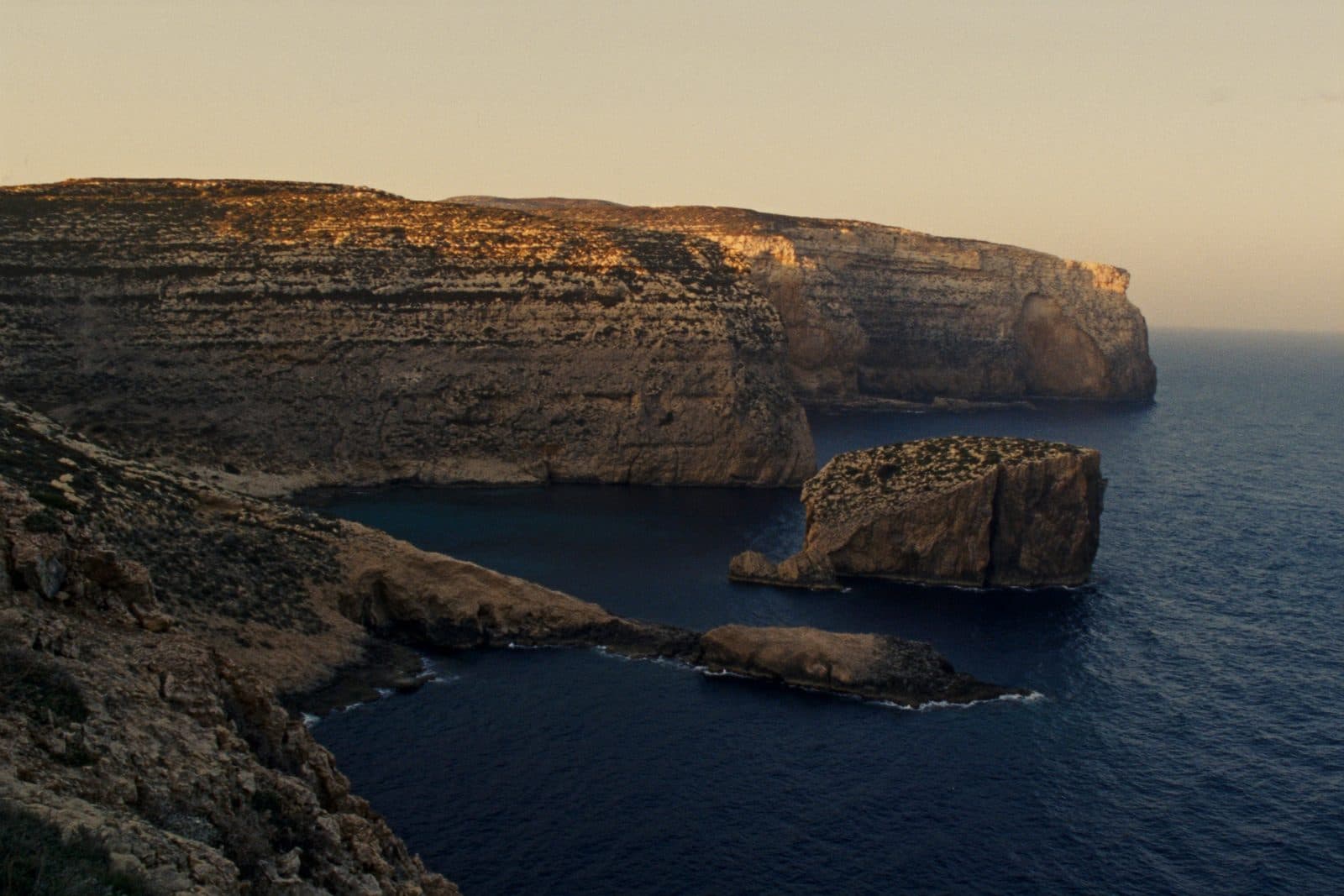
Dwejra, Gozo
Gozo's most dramatic stretch of coast — the Inland Sea lagoon with boat trips through a cliff tunnel, Fungus Rock, and some of Malta's best diving. The Azure Window arch collapsed in 2017 and is gone.
MaltaPathway
Key facts
- Best for
- The Inland Sea — a lagoon linked to the open sea by a natural cliff tunnelSmall boat trips through the tunnel and along the cliffs (weather permitting)Fungus Rock and the dramatic limestone geology of Dwejra BaySome of the best scuba diving and snorkelling in the Maltese islandsWild, cinematic coastal scenery on Gozo's west coastSunset over the cliffs and the open Mediterranean
- Getting there
- Buses connect Victoria with the Dwejra / San Lawrenz area; Victoria is Gozo's transport hub
- Service to this western corner is limited — check times before relying on a specific bus
- From the Mġarr ferry, change in Victoria for Dwejra
- Inland Sea boat trips run only when sea conditions allow; they can be cancelled in wind
- There is little shade and few facilities — bring water and sun protection
- Official site
- https://www.visitmalta.com/
Dwejra, on Gozo's rugged west coast, is the most geologically dramatic place in the Maltese islands. Its centrepiece is the Inland Sea (Il-Qawra), a shallow lagoon cut off from the open Mediterranean by a wall of cliff and connected to it only by a natural tunnel, through which small boats take visitors out to the open sea and along the cliffs when conditions allow. Nearby stand Fungus Rock, a domed islet at the mouth of Dwejra Bay, and the bay itself, one of the best-known dive sites in the Mediterranean. It is important to know that the Azure Window — the famous natural arch that long defined this coast — collapsed into the sea during a storm in March 2017 and no longer exists; visitors come now for the Inland Sea, the rock formations and the diving rather than the arch.
Who this guide is for
- Visitors who want Gozo's most dramatic coastal scenery
- Divers and snorkellers — Dwejra is a renowned dive site
- Anyone expecting the Azure Window (and needing to know it's gone)
What to do with your time
| If you want… | Do this… | Why | Watch out |
|---|---|---|---|
| The signature experience | An Inland Sea boat trip | Through the cliff tunnel to the open sea | Runs only when the sea is calm |
| Dramatic geology | Walk around Dwejra Bay | Fungus Rock and the rock formations | Exposed; little shade |
| Diving or snorkelling | Dwejra Bay dive sites | Among the best in the islands | Go with a local operator/conditions check |
| The Azure Window | Adjust expectations | It collapsed in 2017 | Only the underwater remains are left |
The signature experience
An Inland Sea boat trip
Through the cliff tunnel to the open sea
Watch out Runs only when the sea is calm
Dramatic geology
Walk around Dwejra Bay
Fungus Rock and the rock formations
Watch out Exposed; little shade
Diving or snorkelling
Dwejra Bay dive sites
Among the best in the islands
Watch out Go with a local operator/conditions check
The Azure Window
Adjust expectations
It collapsed in 2017
Watch out Only the underwater remains are left
A geology-and-water destination — the boat trip depends on the sea state.
The Azure Window — what happened
For decades the Azure Window (Tieqa Żerqa), a vast natural limestone arch, was the symbol of Dwejra and one of the most photographed sights in Malta. In March 2017 it collapsed into the sea during a heavy storm and is no longer there. It is worth being clear about this, because many visitors still arrive expecting to see it. What remains is the dramatic coastline it stood on — and, beneath the surface, the fallen blocks of the arch, which have become a notable feature for divers.
The Inland Sea
The Inland Sea (Il-Qawra) is now the headline experience at Dwejra: a sheltered lagoon enclosed by cliffs and joined to the open Mediterranean only by a narrow natural tunnel bored through the rock. In settled weather, local boatmen run short trips from the lagoon out through the tunnel, emerging beneath the cliffs into the open sea with views of the rock faces and caves before returning. The trips depend entirely on conditions and do not run when the sea is rough, so treat them as a highlight to hope for rather than a fixed plan.
Dwejra at a glance
- Location
- Gozo's rugged west coast
- Headline sight
- The Inland Sea + cliff-tunnel boat trips
- Also here
- Fungus Rock, Dwejra Bay
- Azure Window
- Collapsed in March 2017 — no longer exists
- Diving
- Among the best sites in the Maltese islands
Fungus Rock and Dwejra Bay
At the mouth of Dwejra Bay stands Fungus Rock (Il-Ġebla tal-Ġeneral), a large domed islet once prized for a plant used in historic remedies and still off-limits to protect it. The bay itself is a sheltered, dramatic spot ringed by cliffs and is one of the best-known dive sites in the Mediterranean, with clear water, caves and — now — the underwater remains of the Azure Window. Even without diving, the walk around the bay and the cliffs is the scenic heart of a Dwejra visit.
Best time to visit
Spring and early autumn give the calm, settled seas that the Inland Sea boat trips need, with comfortable temperatures for walking the exposed cliffs. Summer is reliably calm but hot and busier; winter brings the storms that make the boat trips unlikely. Whenever you go, the boat depends on the sea state on the day.
Getting here and getting around
Dwejra sits in Gozo's far west, near the village of San Lawrenz, and is reached via Victoria, the island's transport hub. Buses connect the two, but service to this corner is limited, so check the current schedule before relying on a particular bus. Coming from Malta, take the Gozo Channel ferry from Ċirkewwa to Mġarr and change in Victoria. There is little shade and few facilities at Dwejra, so bring water and sun protection. See the Gozo day-trip guide for combining Dwejra with Victoria and the coast.
Common mistakes
- Coming to see the Azure Window — it collapsed in 2017 and is gone.
- Counting on the Inland Sea boat trip — it only runs when the sea is calm.
- Underestimating how exposed and shade-free the site is; bring water and sun cover.
- Relying on frequent buses — service to western Gozo is limited.
- Diving the site without a local operator and a proper conditions check.
About this guide
Maintained by MaltaPathway
This guide is written from public sources and kept up to date where possible. MaltaPathway is an independent visitor guide and is not affiliated with any official body. Source policy, correction policy, and monetization disclosure live on the About and trust page.
Sources
Nearby places
Related guides
Was this page helpful?
MaltaPathway is an independent guide and is not operated by or affiliated with the Government of Malta, VisitMalta, or any other public authority. Details such as opening hours, prices, and schedules can change — always check official or current sources before relying on time-sensitive information.